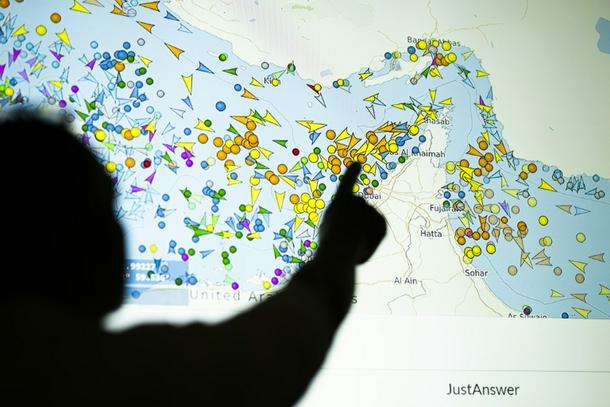
Tracking the limited vessel movements in the Strait of Hormuz since the outbreak of the Middle East war
London (AFP) - Oil prices bounced higher and global stock markets fell Thursday after the United States and Iran exchanged new strikes despite their purported ceasefire, rekindling uncertainty about an end to the Middle East war.
The crude price jumps of around 2.5 percent partly erased Wednesday’s sharp declines on hopes of an imminent deal to stop a conflict that has all but halted shipping through the crucial Strait of Hormuz.
The latest strikes were the most serious since an April ceasefire, and came despite a series of headlines suggesting talks on a deal were progressing.
“A fresh exchange of strikes between the two countries is testing the fragile ceasefire and forcing a reassessment of the chances of a near-term agreement which can reopen the Strait of Hormuz and dial down the pressure the crisis is putting on the global economy,” said AJ Bell investment director Russ Mould.
Stock markets were down across the board with the Dow, the Nasdaq and the S&P 500 all in the red upon opening after the US Federal Reserve’s preferred inflation measure rose in April by its highest year-on-year rate since 2023.
The personal consumption expenditures (PCE) index jumped 3.8 percent from a year ago, the Commerce Department said, in line with expectations and up from 3.5 percent in March as the economic fallout of President Donald Trump’s Iran war continued to hit Americans.
The US also revised down its first-quarter GDP growth to 1.6 percent from 2.0 percent, as investment and consumer spending slowed.
The combination of persistent inflation and slowing growth lowers the chances of interest rate cuts by the Federal Reserve, despite President Donald Trump’s repeated calls for lower rates to support the world’s biggest economy.
“Even after stripping out energy prices, core PCE is sitting at a multi-year high. In response, the Fed has already taken on a more hawkish posturing in response to higher inflation,” said Bret Kenwell, US investment analyst at eToro.
“The concern now is whether higher energy prices begin to filter into non-energy categories, making inflation harder for both consumers and the Fed to look through,” he said.
Major European indices were all struggling, with London and Frankfurt shedding around one percent.
Asia also saw losses, with the main benchmarks in Hong Kong, Taipei and Sydney closing down more than one percent and Shanghai the sole major exchange to buck the trend, adding just 0.1 percent.
The drops came after strong sessions for stock markets Wednesday, as investors, bullish on artificial intelligence, looked past the conflicting headlines on Iran.
- Key figures at around 1345 GMT -
Brent North Sea Crude: UP 2.0 percent at $96.13 a barrel
West Texas Intermediate: UP 2.4 percent at $90.82 a barrel
New York - DOW: DOWN 0.4 percent at 50,448.81 points
New York - S&P 500: DOWN 0.1 percent at 7,510.39
New York - Nasdaq: DOWN 0.3 percent at 26,603.64
London - FTSE 100: DOWN 1.0 percent at 10,400.27
Paris - CAC 40: DOWN 0.6 percent at 8,156.74
Frankfurt - DAX: DOWN 0.8 percent at 24,984.93
Hong Kong - Hang Seng Index: DOWN 1.3 percent at 25,006.16 points (close)
Tokyo - Nikkei 225: DOWN 0.5 percent at 64,693.12 (close)
Shanghai - Composite: UP 0.1 percent at 4,098.64 (close)
Euro/dollar: UP at $1.1633 from $1.1629 on Wednesday
Pound/dollar: DOWN at $1.3417 from $1.3434
Dollar/yen: DOWN at 159.39 from 159.53 yen
Euro/pound: UP at 86.71 from 86.59 pence
burs-bcp/ajb/cw/js