The US-Iran deal to extend the ceasefire is pending approval by President Donald Trump
New York (AFP) - Stock markets were mixed while oil prices fell again on Friday on investor optimism that the United States and Iran would reach a deal to extend their ceasefire – despite Washington and Tehran offering conflicting views on the state of negotiations.
Oil markets have been up and down this week as investors assess the chances of a breakthrough deal that could potentially resume shipping through the crucial Strait of Hormuz.
Those hopes had been briefly dashed by new US military strikes on Iran on Wednesday, countered by the Revolutionary Guard’s targeting of an American airbase in the region.
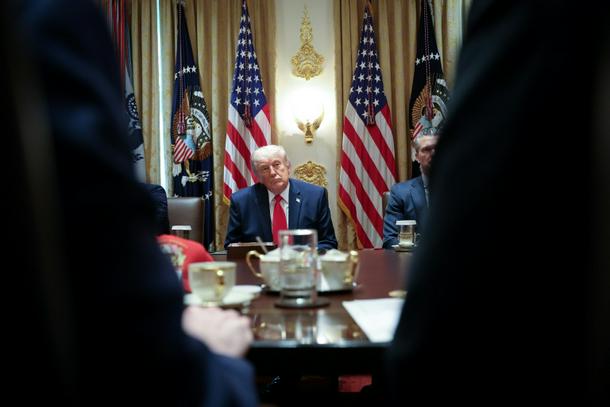
On Friday, US President Donald Trump held a meeting during which he said he would make a “final determination” on a peace deal. Iran’s foreign ministry said negotiations were ongoing and there was no final agreement.
Nevertheless, the reports of progress sent the S&P 500 to a record high before it pared those gains slightly at the close. Other Wall Street indices also rose on Friday, while Europe’s main markets were flat ahead of the weekend.
While details of the possible agreement are scarce, “oil traders are taking an optimistic view that the end could be in sight for disruption in the region,” said Derren Nathan, head of equity research at Hargreaves Lansdown.
However, “the market’s patience may be tested if a deal is not agreed by early June, and this could have big ramifications for the oil price and the global stock market rally,” said Kathleen Brooks, research director at XTB.
Art Hogan of B. Riley Wealth Management told AFP the tech sector was continuing to drive equity markets.
“It looks like we’ll wrap up a ninth consecutive week of higher markets, largely driven by some new names coming out to be beneficiaries of artificial intelligence today,” he said, citing Dell, Micron and SanDisk among individual companies that have delivered big gains.
- European inflation -
In Europe, French data showed Friday that its economy contracted 0.1 percent in the first quarter, while inflation in May accelerated to 2.4 percent, above the ECB’s target of two percent.
Germany saw inflation slow in May to 2.6 percent, though analysts still expect an interest rate hike for the eurozone, possibly at the next ECB meeting on June 11.
Still, “recession risks are easing as oil prices moderate and the probability of worst-case scenarios fades,” wrote Matthew Martin of Oxford Economics.
“While reduced risks from the war have helped, the improvement in equity prices is mostly because of a robust earnings season. The driver is overwhelmingly AI-related capital expenditure,” he said.
Global AI bullishness has driven a historic rally recently, this week pushing the market capitalizations of chipmakers Micron and SK hynix across the $1 trillion threshold.
Seoul’s stock market led the charge in Asia on Friday, surging 3.6 percent while Tokyo’s Nikkei closed at a record high.
- Key figures at around 2000 GMT -
Brent North Sea Crude: DOWN 1.8 percent at $92.05 a barrel
West Texas Intermediate: DOWN 1.7 percent at $87.36 a barrel
New York - DOW: UP 0.7 percent at 51,032.46 points (close)
New York - S&P 500: UP 0.2 percent at 7,580.06 (close)
New York - Nasdaq: UP 0.2 percent at 26,972.62 (close)
London - FTSE 100: DOWN 0.1 percent at 10,416.07 (close)
Paris - CAC 40: DOWN 0.1 percent at 8,183.34 (close)
Frankfurt - DAX: FLAT at 25,104.70 (close)
Hong Kong - Hang Seng Index: UP 0.7 percent at 25,182.39 (close)
Tokyo - Nikkei 225: UP 2.5 percent at 66,329.50 (close)
Shanghai - Composite: DOWN 0.7 percent at 4,068.57 (close)
Euro/dollar: UP at $1.1663 from $1.1647 on Thursday
Pound/dollar: UP at $1.3464 from $1.3441
Dollar/yen: UP at 159.27 from 159.25 yen
Euro/pound: DOWN at 86.63 pence from 86.66 pence