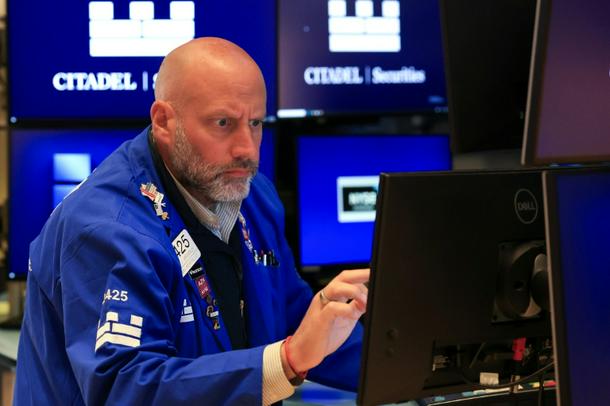
A trader works on the floor of the New York Stock Exchange (NYSE) earlier this week
New York (AFP) - Stock markets mostly fell on Tuesday after a US-Iran truce expired with no progress towards reopening the Strait of Hormuz, adding to fears that higher energy prices will drive up inflation.
Those inflation worries drove government bond yields to their highest levels in almost two decades, further undermining stocks.
While soft US data this month has eased concerns that the Federal Reserve will raise interest rates soon, traders still expect inflation to remain above central bank targets for some time as the Middle East crisis drags on and crude stays stuck around $90 a barrel.
US 10-year Treasuries are yielding more than 4.70 percent, levels not seen since June 2007, just before the global financial crisis exploded.
That is unwelcome news for millions of American borrowers as well as for tech companies cranking up borrowings to fund AI investments.
“A sharp rise in government bond yields around the world may start to pose a threat to equity valuations and make life even trickier for deeply indebted nations and policymakers,” said Neil Wilson, investor strategist at Saxo UK.
“A significant part of the problem in the very near term is oil and energy prices,” he added.
In France, the 10-year government bond yield reached its highest level since 2008 on Tuesday as European borrowing costs surged.
After hitting or flirting with record highs last week, New York’s three main indices fell for a third straight session.
The tech-heavy Nasdaq dropped the most at about 1.3 percent, as Nvidia slumped more than two percent and Intel around seven percent.
“There has been a reversal in fortune for the stock market so far this week, with increased attention to rising bond yields and oil prices,” said Patrick J. O’Hare, an analyst at Briefing.com.
Frankfurt and Paris both closed almost a percent lower while London – which has more major energy companies in its FTSE index – was supported by higher oil prices.
BP shares closed up almost 3 percent and Shell almost 2 percent, as London’s main index gained 0.1 percent.
Both main crude contracts remained elevated on Tuesday after gaining the previous day, with the Brent benchmark sitting over $90 a barrel.
The chances of an agreement between Washington and Tehran remain thin after US President Donald Trump said he would not extend a 60-day truce, while Iran called it “irrelevant” because, it argued, the United States had violated it early on.
Trump’s envoy and son-in-law Jared Kushner had said on Monday that the United States and Iran were having “very positive and active conversations,” but the president denied that was the case.
“There are no talks or conversations going on, or scheduled, with the Islamic Republic of Iran. The Naval Blockade remains in full force and effect,” Trump wrote on his Truth Social network.
Washington and Tehran both appear content to play a long game, which investors fear could mean prices will stay higher for some time.
Asian stocks mostly fell following Monday’s losses on Wall Street.
Tokyo was off more than two percent, while Seoul and Taipei were down more than one percent. Both Hong Kong and Shanghai edged higher.
- Key figures at around 2020 GMT -
New York - DOW: DOWN 0.2 percent at 53,343.40 (close)
New York - S&P 500: DOWN 0.7 percent at 7,691.76 (close)
New York - Nasdaq Composite: DOWN 1.3 percent at 26,289.71 (close)
London - FTSE 100: UP 0.1 percent at 10,728.04 (close)
Paris - CAC 40: DOWN 0.8 percent at 8,509.36 (close)
Frankfurt - DAX: DOWN 0.8 percent at 26,128.36 (close)
Tokyo - Nikkei 225: DOWN 2.5 percent at 67,460.73 (close)
Hong Kong - Hang Seng Index: UP 0.1 percent at 25,471.15 (close)
Shanghai - Composite: UP 0.2 percent at 3,990.30 (close)
West Texas Intermediate: UP 0.5 percent at $84.94 per barrel
Brent North Sea Crude: UP 0.2 percent at $91.02 per barrel
Euro/dollar: DOWN at $1.1577 from $1.1580 on Monday
Pound/dollar: DOWN at $1.3533 from $1.3544
Dollar/yen: UP at 159.64 yen from 159.46 yen
Euro/pound: UP at 85.53 pence from 85.50 pence