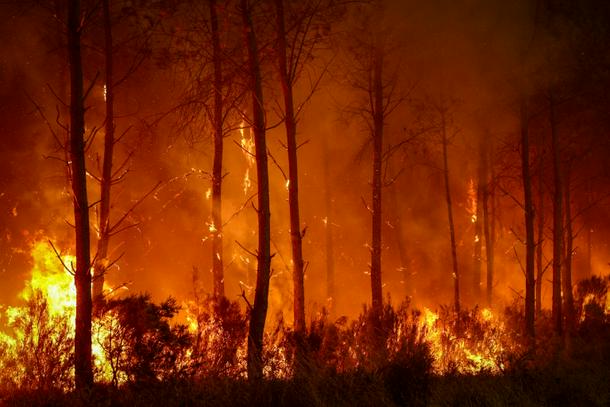
Fires have been raging in southwest France and west of the Spanish capital, Madrid, for days
Navaluenga (Spain) (AFP) - President Emmanuel Macron on Monday said one forest fire in southwest France had been “contained” even as another, much bigger one near Bordeaux continued to rage, and western Europe braced for new heatwaves this week.
France and Spain are battling the worst wildfires in living memory, which have ripped through hundreds of hectares of woodland, destroying properties and forcing evacuations of hundreds of thousands of people.
The return of searing temperatures, from Tuesday in France and from Wednesday in Spain, threaten to complicate fire-fighting efforts.
Spanish Interior Minister Fernando Grande-Marlaska said the coming hours would be “absolutely decisive” to bring fires burning west of the capital, Madrid, under control.
Macron, on a visit to a crisis centre in the winemaking capital of Bordeaux, said: “The coming weeks will be tough and we have to hold out.”
That southwestern city, in the Gironde region, lies just short distance from a vast and turbulent wildfire that is creating its own winds and sparking fresh blazes around it.
That unchecked, gigantic blaze – which has created a rare pyrocumulonimbus cloud packing lightning – has over the past six days ravaged 42,000 hectares (103,000 acres), forced 220,000 people to flee and destroyed 240 houses.
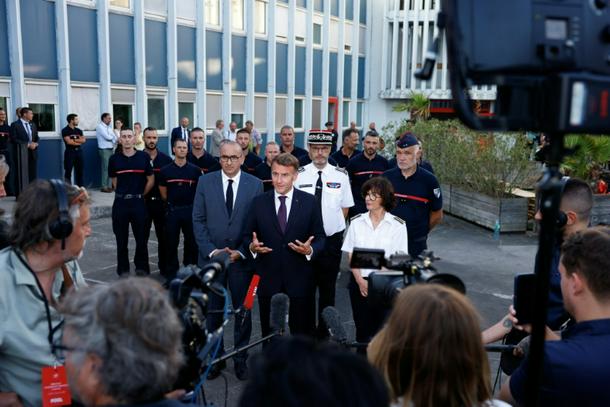
French President Emmanuel Macron put the fires down to the 'conditions of climate change in which we will live'
Macron said a smaller fire in the adjoining Landes – which had nonetheless forced the evacuation of more than 30,000 people – was now “contained”.
But he warned it “remains virulent and we must be extremely cautious over the next few hours and the coming days”.
This was due to the “conditions of climate change in which we will live,” he said.
- ‘Lost everything’ -
In Spain, where blazes were burning west of Madrid, some 60,000 people have also been evacuated.
At a sports hall just outside Madrid, displaced people sprawled on camp beds, held their heads in their hands and comforted pets.
Maria Angeles Canete fought back tears as she looked around the desolation that used to be her campsite near Navaluenga, west of the capital.
“We lost everything,” she said. “We had this campsite, we had another one, and we’ve lost it all. We have nothing.”
The European Union on Monday announced more water-bombing planes were being sent to France, in addition to those already deployed to Spain.
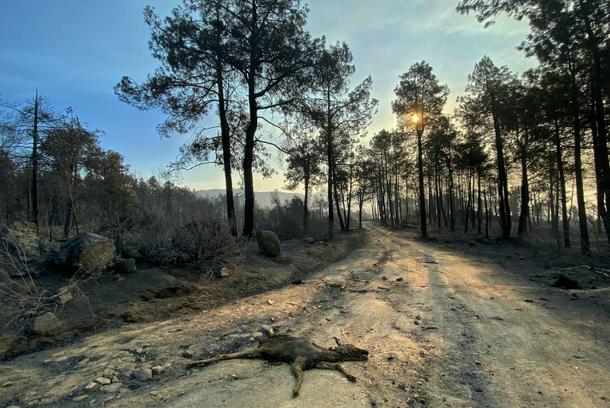
The fires - widely blamed on human-driven climate change -have devastated land, forests and wildlife
But EU commissioner Hadja Lahbib told AFP that its fleet was increasingly stretched due to fears they may soon be needed elsewhere.
“Extreme conditions are looming for Hungary, Slovakia and the Czech Republic, in addition to France, the Iberian Peninsula… where the situation is expected to worsen, including in Portugal starting today,” Lahbib said.
- Devastation -
The scale of the devastation from the fires is vast in the worst-affected areas.
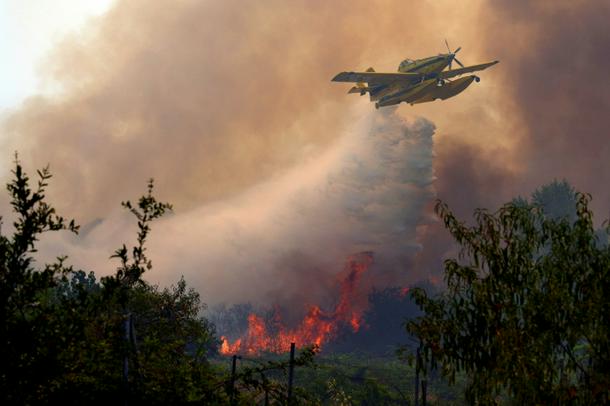
The European Union says its emergency fleet of water-bombing planes is stretched
Pine trees smouldered with blackened trunks and smoke rose from charred forests, with the burnt-out husks of cars and houses reduced to shells, AFP reporters said.
“You run to save what you can and then you turn to defend,” said Karim Benali, 39, a volunteer firefighter on a road near Navaluenga, in Spain.
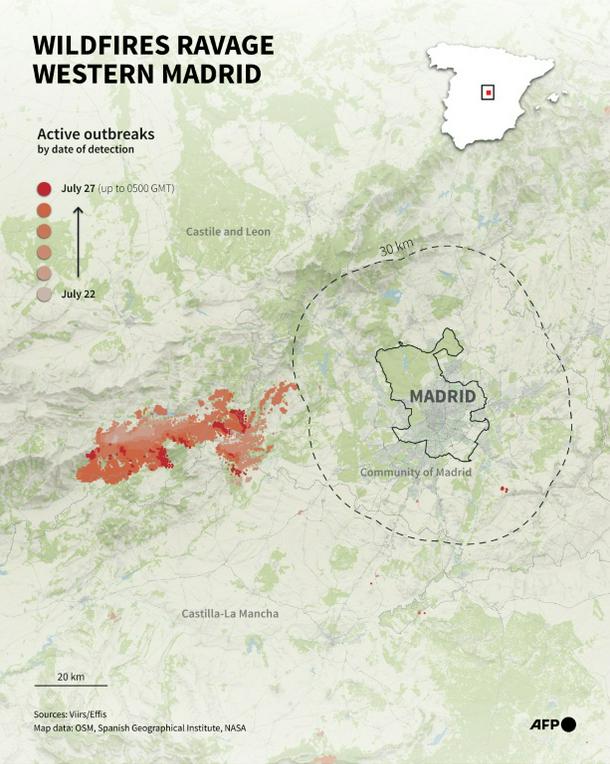
The Spanish fires erupted west of Madrid
That country has seen 77,000 hectares – nearly the size of New York City – destroyed.
David Sanchez, a 48-year-old, had just returned home to Cebreros after evacuating at the weekend to find that his small olive and pistachio grove had been consumed.
“Now it’s time to clean up and plant again and that’s it…And the fire has flared up again down there,” he said, surrounded by choking air that stung the eyes and throat.
Some 150,000 hectares of land have burned in Spain and 115,000 hectares in France since the start of this year.
Earlier this month, 13 people were killed in a wildfire in southwestern Spain while flames ripped through the UNESCO-listed Fontainebleau forest south of Paris.
Near Bordeaux in France, tractors fitted with blades to clear land, pickups towing water tanks and logging trucks sped to join a convoy of fire engines.
“We want to help,” said farmer and wood transporter Christopher Bonnefond, 25, in the village of Marcheprime, in the Gironde region.
“I’m a hunter and I want nature to stay like it is.”
- Climate change -
Spain’s Prime Minister Pedro Sanchez has called the fires “the most painful expression of a climate emergency”.
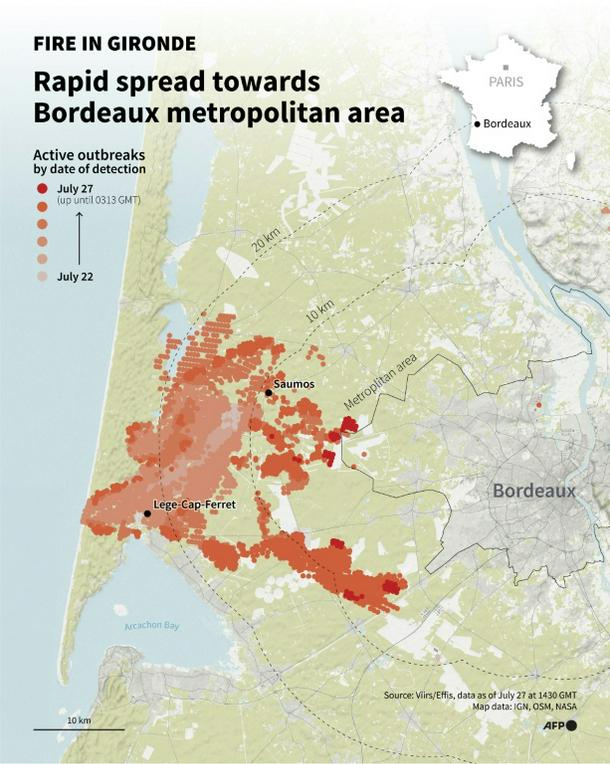
The area west of Bordeaux in southwest France is most affected
Spain’s weather agency AEMET announced a new heatwave starting Wednesday until the end of the week, with temperatures forecast to hit 42C in the northeast and 39C in the centre.
“The wildfire danger level will continue to increase, reaching extreme levels and making firefighting efforts more difficult due to high temperatures, locally gusty southerly winds and widespread low humidity,” AEMET said in a statement.
MeteoFrance also forecast more hot weather of up to 40C from Tuesday with dry wind.
burs-ach/rmb